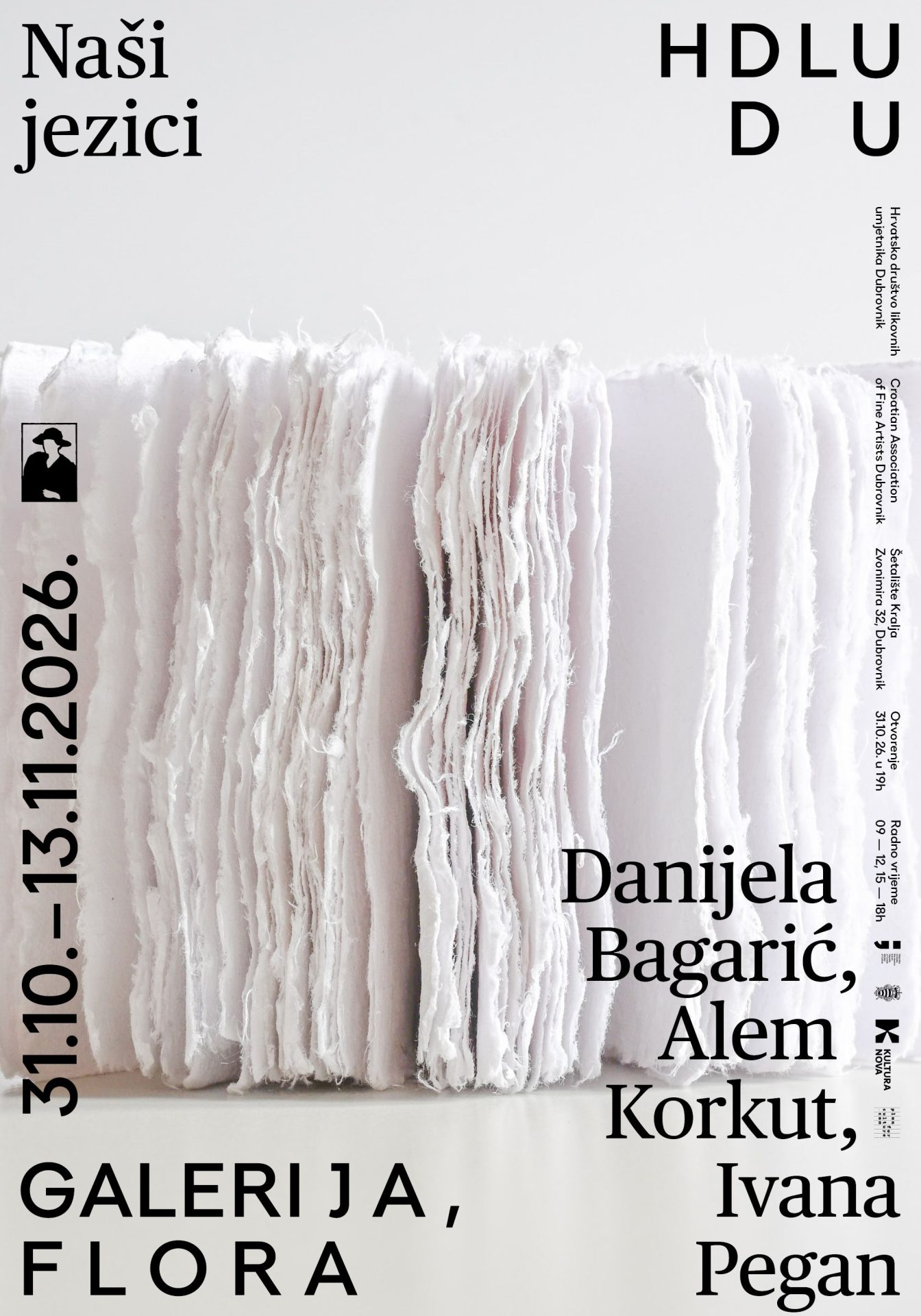

Exhibition _Bagarić Korkut Pegan, Our Languages
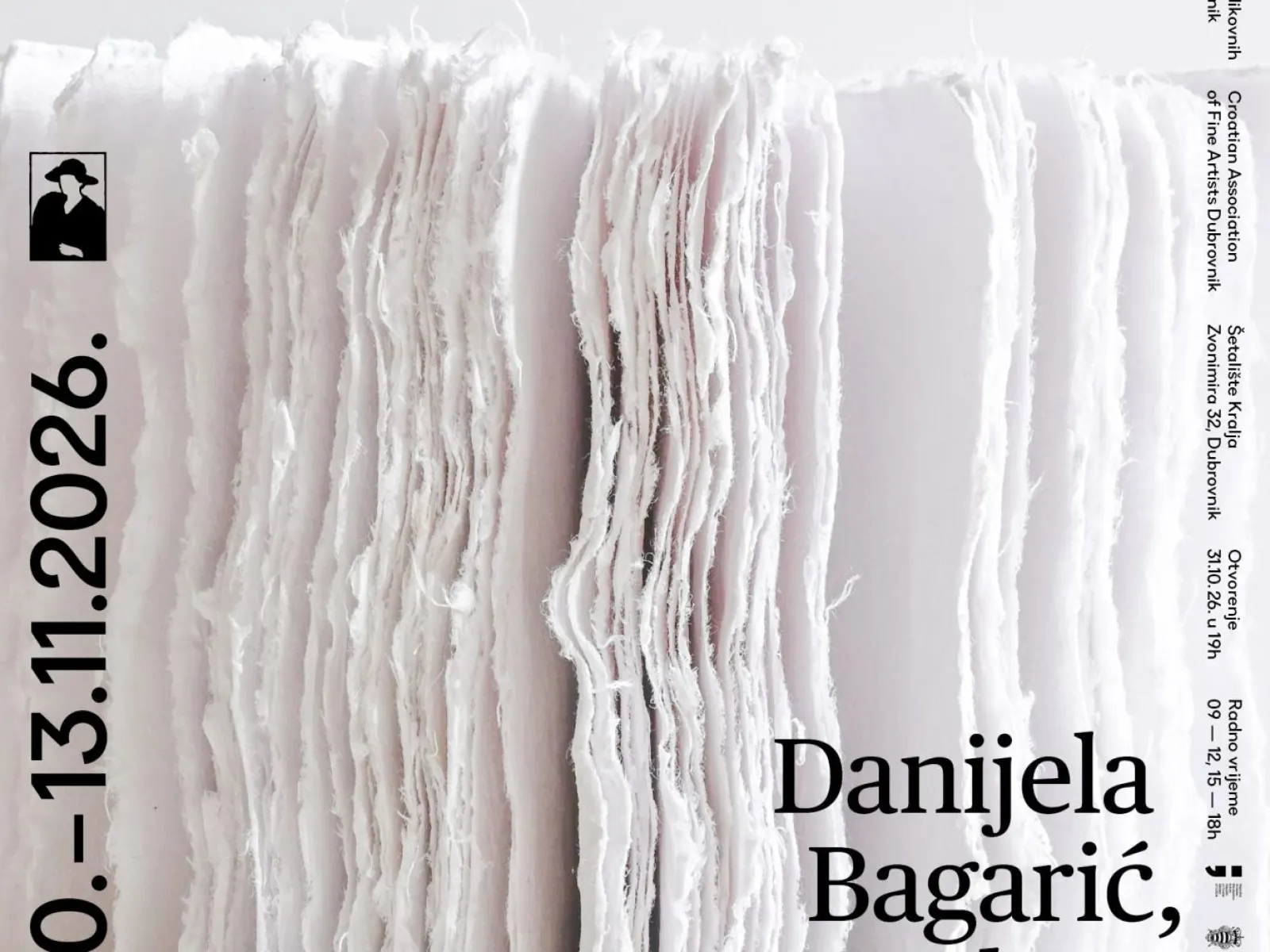
The exhibition can be viewed until November 13, every day from 9:00 to 12:00 and from 15:00 to 18:00.
Life shapes us in ways we often come to understand only with hindsight. The places we live in, the people we meet and the circumstances in which we find ourselves leave their mark on our speech, our memories and the way we see the world. In the works of Danijela Bagarić, Ivana Pegan and Alem Korkut, these traces take different forms: sentences, prints made with light and reliefs that resemble writing.
Danijela Bagarić writes about the life she lives and those she might have lived, if circumstances had been different. In her texts, her relocation from Bosnia to Austria raises questions of language, belonging and the possibilities open to her. The sentences are the result of lengthy reflection on experience and its consequences. Incised into white oil paint, they reveal the blue layer underneath, as though a thought were passing through layers of time before becoming visible. Alongside the texts on the walls, the artist presents a small white book. Its intimate format invites a personal reading. Handwritten in Croatian and German, it brings together the two languages of her life, while the soft traces of graphite give the book a sense of fragility and change.
During her art residency in Zagreb, Ivana Pegan observes the morning light and the changes it brings to a space. In her cyanotypes, she combines photographs from her own archive with shadows and fields of color. An empty chair, details of the body and other fragments come together in images arising from careful observation and intuitive connections. Each print is connected to a particular moment, place and length of exposure to sunlight. The works therefore preserve something of an experience that belonged only to that time.
In Alphabet of Glossolalia, Alem Korkut explores speech made up of spontaneous sounds and syllables, associated in religious contexts with spiritual ecstasy and described in psychology and linguistics as a pseudo-language. The principle behind this unintelligible speech resembles the one Korkut uses in creating his alphabet: control over the process is limited to the initial idea, while the shaping is left to chance. Just as a person speaking in tongues bypasses reason and allows unarticulated sounds to flow through them, the sculptor bypasses the mould, letting molten aluminium flow freely and react with the ground. In both cases, the conscious mind merely sets the process in motion, while the final form, whether it is a spoken syllable or a metal relief, emerges in a moment of complete surrender to chance. The metal takes shape in contact with the ground, creating signs that evoke writing and speech while remaining open to personal interpretation.
All three artists develop a restrained visual language, but each achieves an intense expression in their own way. Danijela Bagarić reflects on identity through sentences, Ivana Pegan brings together images, light and memory, and Alem Korkut allows metal to find its form in contact with sand. Their approaches differ, but in each of them, personal experience is transformed into something we can see, read or feel. Each work opens up a different way of seeing, and its meaning continues to assume form in the encounter with the viewer.
Dora Lučić
Danijela Bagarić is a visual artist living and working in Wels, Austria. Her practice encompasses painting, drawing, printmaking, objects and process-based explorations of materials. She investigates how perception, memory and inner states take material form. Color, line, layers, surface and light define works whose appearance changes with the viewer’s perspective and the surrounding space. Time, silence, vulnerability and transformation become visual experiences. Bagarić was born in 1976 in Bugojno, Bosnia and Herzegovina, and has lived in Austria since 1992. From 2015 to 2021, she studied fine art under Professor Ursula Hübner at the Linz University of Art and Design, where she graduated. She has presented her art in Austria and internationally, and her works are held in public and private collections.
Alem Korkut was born in 1970 in Travnik. He completed elementary and high school in Banja Luka. He graduated in sculpture from the Academy of Fine Arts in Zagreb in 1997. He is the author of several public sculptures, and the recipient of multiple professional awards and prizes in competitions for sculptures in public spaces. He has exhibited in around fifty solo and about two hundred group exhibitions in Croatia and abroad. From 1998 to 2007, he was a member of Croatian Association of Independent Artists with the status of an independent artist. Since 2007, he has been teaching sculpture at the Academy of Fine Arts in Zagreb. He is the president of the Art Organization Atelijeri Žitnjak.
Ivana Pegan, in her recent work, uses photography, language, writing, speech, and voice, finding expression in the media of artist’s books, poetic objects, audio and video works. Through diary entries, fragmentary texts, poetry, short stories, and grammar quizzes, as well as through visual and sound works (spoken word), she examines in her own voice the ways in which the subject is constituted, focusing on the emotional, mental and vocal potential of exceeding social conventions and established boundaries. She graduated from the Academy of Fine Arts in Zagreb, the Sculpture Department, in the class of prof. Šime Vulas, in 1996. She is a member of the Croatian Association of Independent Artists, the Croatian Association of Visual Artists Dubrovnik, the Lazareti Art Workshop Dubrovnik and the arts organisation Tkivo. Since 2014, she runs the Flora Gallery, which also deals with art restoration.