

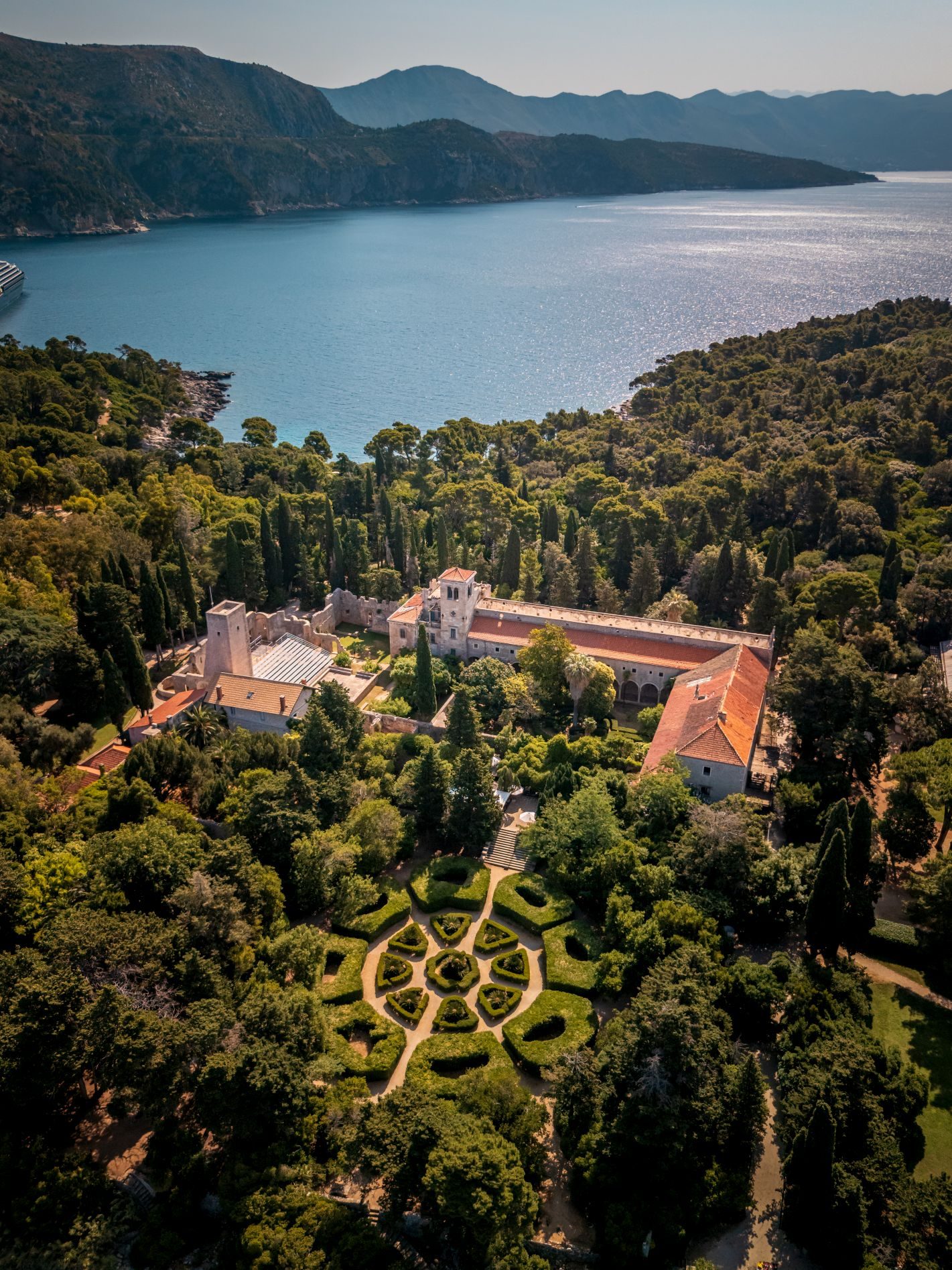
The Benedictine monastery and church on the island of Lokrum were founded at the beginning of the 11th century. During the 12th century, the monastery entered a period of considerable growth and prosperity, and in the second half of the century the complex was expanded with the construction of a new three-nave church with three apses.
Of the original Romanesque monastery and its adjoining cloister, the western wing, which served an economic and practical function, has survived to the present day, with a mill on its ground floor. Of the eastern wing, once home to the monks’ dormitory, only sections of the outer walls remain.
Following the Observant reform, the monks of Lokrum expanded the monastery and constructed a new Renaissance cloister. This important architectural ensemble is significant not only within the context of Dubrovnik, but also on a much broader scale.
The eastern wing of the cloister was designed according to a distinctive form of monastic architecture known as the manica lunga — Italian for “long sleeve” — referring to the arrangement of a monastery wing containing the dormitory.